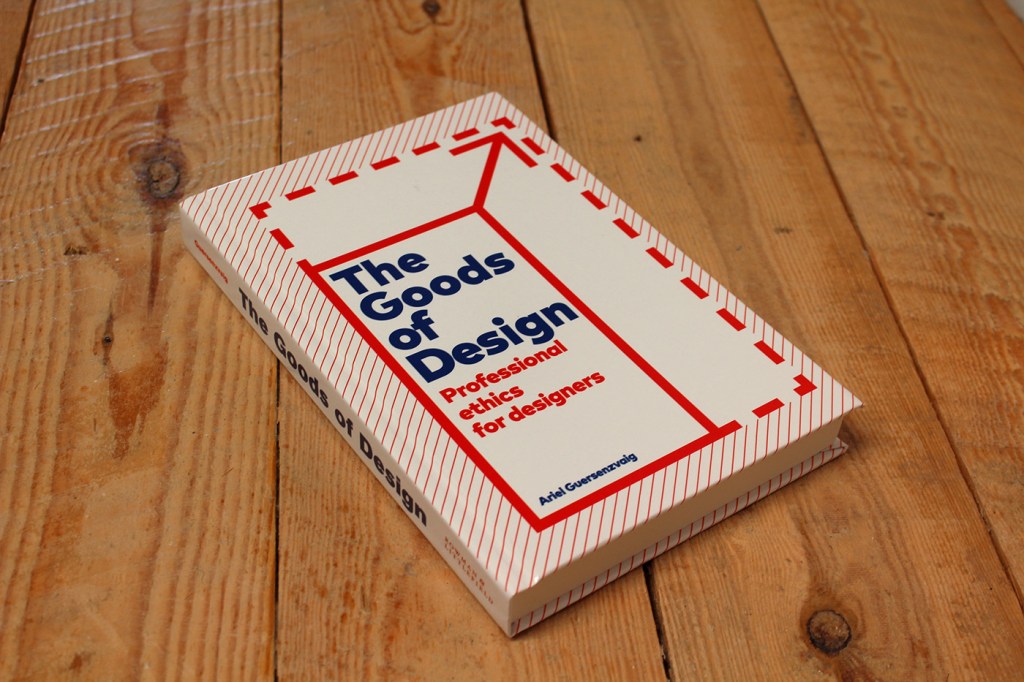
The Goods of Design: Professional Ethics for Designers
Listed as a 2022 Choice Reviews Outstanding Academic Title, a prestigious list published by the American Library Association reflecting the best in scholarly titles reviewed by Choice during the previous year.
“Essential. All readers.” Choice
Back-cover description:
What ends should designers pursue? To what extent should they care about the societal and environmental impact of their work? And why should they care at all? Given the key influence design has on the way people live their lives, designing is fraught with ethical issues. Yet, unlike education or nursing, it lacks widespread professional principles for addressing these issues.
Rooted in a communitarian view of design practice, this lively and accessible book examines design through the lens of professions, offering a critical vision that enables practitioners, academics and students of design in all disciplines to reflect on the practice’s overarching purposes. Considering how these are connected to others’ flourishing and moulded by community interactions, “The Goods of Design” argues for a practice-based approach to cultivate professional ethics; it provides a normative direction that can meaningfully guide professional design activity, both individually and collectively. The volume also looks into the implications work has for the designer’s self-growth as a person, offering ways to discover and navigate the complex tensions between personal and professional life.
The book is part of the Bloomsbury Collections, which means you can access it online with a subscription. Summaries are available if you don’t have one.
Read a preview on Google Books.
Published by Rowman & Littlefield Publishers
Hardback: 978-1-78661-540-4 • April 2021 • (308 Pages)
Paperback • 978-1-5381-7991-8 • February 2023 • (308 Pages)
eBook • 978-1-78661-542-8 • April 2021
Reviews
Readers, take note! Despite the title’s pun, this important book does not focus on the trending topics of the “stuff” or materiality of design. Instead, goods as used here references the ethics of design and design practice as viewed through the lens of virtue ethics. This approach, grounded in ancient philosophers such as Confucius and Aristotle, then elaborated by contemporary philosopher Alisdair MacIntyre, questions the nature of the good life and what sort of person one should be. This philosophically grounded treatise establishes the need for a professional ethics for designers, then authorizes and encourages designers to act ethically. Philosopher, design theorist, and educator Ariel Guersenzvaig offers a critical, much-needed examination of the relatively young profession of design, providing an overview of an ethics of design practice. Unlike manifesto authors, Guersenzvaig eschews oversimplification and ranting and instead proceeds at a measured pace, providing a philosophically reasoned argument with lively accessible language supported by deep and timely scholarly references. A noteworthy bibliography compiles and expands on these excellent resources with handy topical categorization. Educators will especially appreciate the coda, “Teaching Design Professional Ethics.”
Essential. All readers.
— Choice Reviews
In a turbulent world where everyone designs, who are the professional designers? What characterises their specific role? Finally a book looks at these questions seriously. And it starts with the most difficult one: what ethics should apply to professional designers? Ariel Guersenzvaig offers an updated and critical track with which to discuss this crucial issue.
— Ezio Manzini, Desis Network
Especially with today’s complex societal challenges, this engaging book is a must-read for all designers, be it a professional designer, a design educator, or design student. By diving into virtue ethics, Ariel Guersenzvaig clarifies and inspires designers to approach the design profession as a practice, and with their practical wisdom to care for and contribute to society. This book takes you on an inspiring and precious ethical journey that emphasizes the importance of learning and self-growth to become virtuous designers who can contribute to the goods of design and society.
— Caroline Hummels, Full Professor in Design and Theory for Transformative Qualities at Eindhoven University of Technology
The challenges we face nowadays as individuals, collectives and societies are extremely demanding on the design disciplines. How can professional designers cope with emerging areas of activity without losing orientation, and without losing sight of the opportunities and boundaries of the discipline? Finally, here is a book that offers an in-depth engagement with those fundamental questions for design professionals. How can we ethically frame our efforts and endeavours? What does it mean to practice design as a profession in a society where design strategies might contribute to even deepen current crises? With this inspiring volume, Ariel Guersenzvaig poses the right questions for designers to ask as professionals and individuals.
— Bianca Herlo, Weizenbaum Institute for the Networked Society, Berlin University of the Arts (UdK)
I only hope that this book puts an end to the idea that a handful of aspirational phrases will suffice when it comes to the practice of ethics in design rather than applying that degree of dedicated awareness that is required in professional practice. In this regard, this volume could set a standard, a turning point, in a field where we need, both as a sector, and as a viable society, a solid basis of thought rather than a bunch of proverbs. The Goods of Design raises more questions, and the means to ask them, than certainties – thanks for that too. This book cautiously whispers to those who consider that personal and professional ethics are separate compartments, but is directly aimed to those who know or sense, even deep inside, that they are not.
— Nacho Padilla, Creative Director, Barcelona City Council
As design is increasingly embedded in every aspect of our world and lives, its impact in shaping our reality becomes undeniable. How can designers consciously embrace such responsibility? In The Goods of Design Ariel Guersenzvaig navigates the professional and personal tensions and dilemmas associated with the ethics of making design decisions. But rather than laying out a prescriptive set of rules, this book masterfully articulates an inspiring thread of questions and arguments that challenge the reader and will undoubtedly advance design professional ethics.
— Mara Balestrini, Human Computer Interaction scholar and former CEO, Ideas for Change
The Goods of Design: Professional Ethics for Designers succeeds, with qualifications, as a timely advancement in applied virtue-ethical theory. […] Guersenzvaig’s book is one the most readable I have picked up in years[…].
— Metaphilosophy
The Goods of Design presents a much needed, highly relevant, and extremely intelligent example of a theoretical oeuvre that comes from and is dedicated to practitioners. The examples are eye-opening and varied and the book’s importance to all the various sub-disciplines of design is highly valuable. Furthermore, the mixture between philosophy and design theories is welcomed. Finally, I find the introduction of MacIntyrian theories to design practice a brilliant move and hopefully other researchers and educators will follow Guersenzvaig’s path.
— International Journal of Technology and Design Education
 Ariel Guersenzvaig, PhD